

17 December 2025
Why Some Properties Outperform Bitcoin (& Every Other Asset)
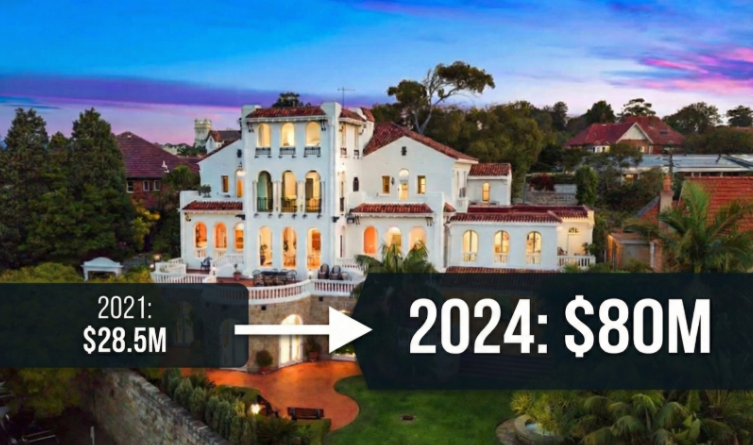 Property has long been considered the most stable investment globally, a safe haven that makes it the world's largest asset class at $393.3 trillion USD (Savills). But for this fact, most think it's impossible for real estate to outperform something as high growth and speculative as Bitcoin.
The value of most property is tethered to local incomes and borrowing capacity, meaning there's a hard ceiling on where prices can go. This is mostly true for 99.9% of properties around the world. But there's a small subset that break this mould. Not through leverage or luck, but through a completely different set of market dynamics, this is the asset class that consistently outperforms.
The Outperformers (The 0.1%)
This isn't a hypothetical, there are many properties and markets that consistently outperform Bitcoin.
In 2021, Alcooringa (see above image) sold for $28.5M. In 2024, it sold again for $80M to an overseas buyer. That's 180% in just 4 years. Bitcoin did roughly 60% in the same period. And no, the house wasn't rebuilt or rezoned. It's the same property.
Edgewater in Point Piper is another, previously a literal concrete shell on the waterfront of Australia's most expensive suburb, sold for $95M in 2020. It last sold for $5M.
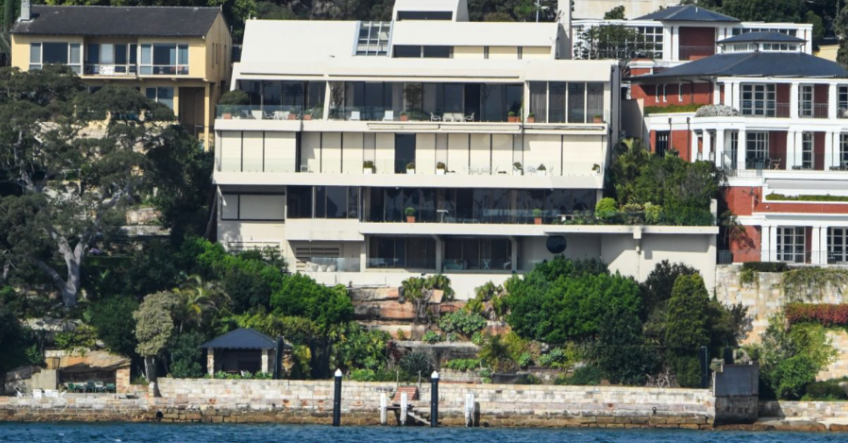
You may think these are anomalies, and in terms of absolute number of sales, they are. But extrapolate and a pattern emerges. They cluster in specific pockets around the world, where irreplicable dynamics push certain properties to the centre of the global wealth stage. In these areas, sales like these happen more often than you'd expect.
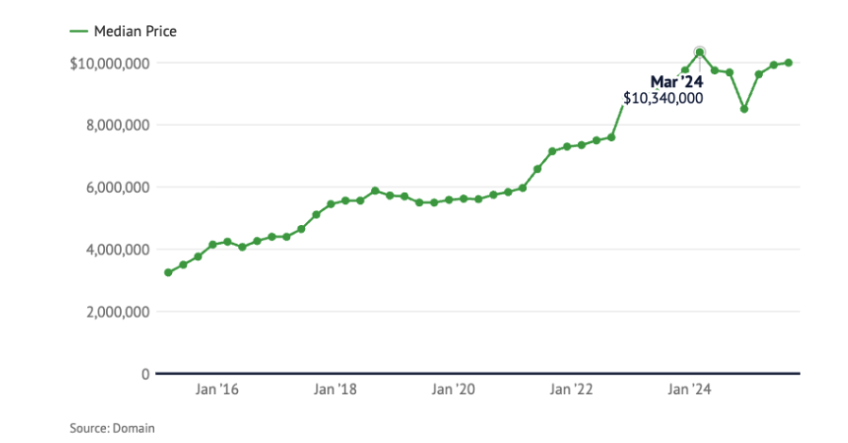
Australia's prestigious Bellevue Hill is an example. The median house price hit $10M in 2024, up from $5.7M in 2020.
Bellevue Hill's median house price over the past decade
So what are the unique dynamics driving these gains?
A Market of Their Own
What we've observed is that there's two parallel markets running in real estate:
Average Market
Most property markets move with interest rate cycles and employment data. It's the 3-bed in the suburbs that stretches a dual-income couple to their limit. Prices are tied to wages, mortgage rates, and borrowing capacity. Structurally, growth is capped. Most properties below $5M can probably be classified here.
0.1% Market
Properties in this segment are in a market of their own, operating on completely different drivers. On the surface it's the $15M+ trophy homes, harbour views, and heritage estates that represent the pinnacle of residential living. But beneath the surface, it's a market tied to global capital flows, scarcity, status, and safe haven demand. Think Monaco, parts of Sydney, Singapore and Hong Kong. These assets transact in their own circles, often off market. The market is global and demand is ever-present, with an elite group of multimillionaires and billionaires, new and old, always looking to park, move and protect capital.
Driving Forces for Outperformance
1. Global Capital Seeking Safe Haven
Geopolitical uncertainty in the two largest global economies means diversification is an active consideration for global wealth. Preservation is becoming the priority. And when you need to move capital somewhere safe, or somewhere it can't be easily clawed back, real estate in stable jurisdictions becomes an obvious choice.
And it's not just about protection or even the actual property itself. It's about optionality, diversifying across currencies, hedging against domestic policy shifts, setting up the next generation in a stable country. For many, it's securing a pathway to residency. If you're going to make an onshore investment in a country you may one day seek residency in, property is the most sensible choice.
For decades, Hong Kong was the haven for mainland China's newly minted billionaires. But that's shifted to havens like Sydney and Singapore in recent years. Prices have plateaued, liquidity issues are mounting, and political proximity to Beijing has become a liability. Sydney now ranks as the world's second-highest metro city for capital inflows, just behind New York. Sales records in the eastern suburbs make headlines weekly, and the buyer profile is remarkably consistent.
2. Scarcity That Can't Be Built
Scarcity in this market isn't about any single factor. It's the combination: political stability, liveable climate, proximity to global hubs, and then even more micro factors: the suburb, the street, the views, the land size. Each factor narrows the pool and by the time you filter for all of them, you're left with a handful (if you're lucky) of properties in the world. That's what drives the 0.1% to outperform.
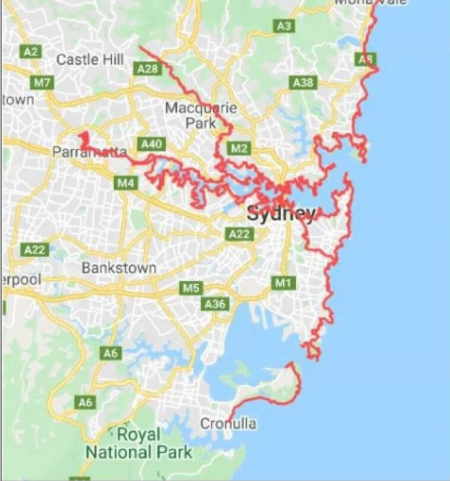
Sydney is one of the clearest examples. Most global capitals come with trade-offs - too hot, too cold, polluted, overdeveloped. Sydney might be slightly boring (for some), but for buyers prioritising political safety, liveability, and proximity to Asia, it's hard to beat. The city itself is actually quite diverse (culturally, economically and aesthetically), but within it, there are only so many waterfront blocks in Vaucluse, only so many harbour views in Mosman. The average Australian house only recently surpassed $1M. The 0.1% we're talking about are a needle in a haystack.
You can print money, build more apartments. You can't create more bridgeview waterfront land in a global safe haven. That's precisely why it attracts the wealthiest.
3. Status Symbol
Sometimes, the wealthiest people you meet can often be the most humble. No flashy cars or branded clothing. For this elite group, property is the ultimate status symbol. Because most things can be faked, but without true wealth, there is no ownership in these 0.1% assets.
For new money, the challenge isn't having wealth. It's signalling it while remaining humble in a world where loud displays are frowned upon. The quiet version is owning the property in the right suburb in the right city, membership to the right clubs, access to rooms most people don't know exist. These suburbs are in themselves exclusive networks. Ask any owner and they'll tell you which billionaire lives in which house on their street. You're not just buying property, you're buying into a community.
This is why trophy property demand isn't price-sensitive the way normal property is. To these buyers, $80M versus $100M doesn't matter. The value isn't in the price. It's in what ownership represents.
4. Strategic Financing
For the average buyer, a mortgage is a necessity. For the mega wealthy, it's completely different. These buyers could pay cash outright, but they often don't and instead, they finance against the asset to pull liquidity back out. Buy a $50M property, take out a loan against it, and suddenly you've got $30M or $40M back in your disposal to deploy elsewhere. And because borrowed money isn't taxed, you access that equity without triggering capital gains. The asset continues to appreciate and you've got liquidity in hand.
And it doesn't stop at one loan. Look at the titles on some of these properties and you'll find second mortgages, lines of credit, multiple caveats stacked on top of each other. The property becomes a credit facility that happens to have a harbour view.
As the saying goes, if you owe the bank $100,000, the bank owns you. If you owe them $100M, you own the bank.
Banks are more than happy to facilitate. A billionaire with a trophy property and the balance sheet to match doesn't get rejected. The bank wants the relationship, not just the loan.
This is also why prices stay elevated. When lenders finance against whatever was paid, it validates the number. The property is worth $80M because someone paid $80M, and a bank agreed to lend against it. The price is now the new floor.
Is There a Limit in Sight?
Growth of these 0.1% assets in global safe havens like Sydney, Monaco, and Singapore has been meteoric. Understandably, people think house prices have surely reached a limit, that a $100M sale is the ceiling.
But $100M seemed like an impossibility ten years ago.
To foreign buyers, markets like Sydney feel "cheap", especially when priced in USD terms. Houses in Hong Kong have sold for over $1 billion AUD. By that measure, a $100M mansion in Point Piper is a bargain to the person trying to move part of their fortune offshore. For American buyers, a weakening Australian dollar has made entry even more attractive for the billionaires benefitting from the AI boom. What looked expensive five years ago now comes at a 20% discount.
Sydney's top-end growth is now outpacing Hong Kong's, as a more attractive place to diversify, more stability, and more room to run. For global capital seeking safety, it's the obvious destination.
Gaining Access
These properties outperform because of structural forces that aren't going away, and if anything are just getting started: global capital seeking safety, fixed supply, status psychology, and financing dynamics that reinforce seemingly outrageous valuations.
But this has always been the asset class the average person couldn't access.
Loaf Markets is changing that. For the first time, the 0.1% is becoming accessible to more than just the 0.1%.
Invest in Trophy Property
Loaf Markets is building fractional, liquid access to Australia's trophy property market.